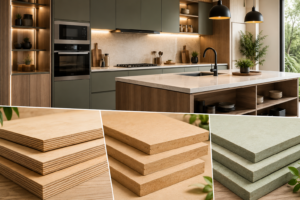
 Designing a modular kitchen is not only about selecting beautiful colours, stylish cabinets, and modern finishes. The material used inside the cabinets plays an important role in determining the kitchen’s strength, durability, moisture resistance, and overall lifespan.
Since kitchens are regularly exposed to heat, steam, moisture, oil, and heavy utensils, selecting the best material for a modular kitchen is essential. Plywood, MDF, and HDHMR are among the most commonly considered materials for modern kitchen interiors.
If you are planning a new kitchen or renovating an existing one, understanding the differences between these materials can help you make a better decision.
At Nest In Modulars, we create customized interiors with a focus on quality materials, functionality, smart storage, and contemporary designs. Explore our Modular Kitchen Designs in Hyderabad to discover kitchen solutions designed around different spaces and requirements.
Why Does the Right Modular Kitchen Material Matter?
Kitchen cabinets experience much more demanding conditions than ordinary furniture. They need to support utensils, appliances, groceries, drawers, hardware, and countertops while also dealing with moisture and regular cleaning.
The right kitchen material can provide:
- Better strength and durability
- Improved moisture resistance
- Stronger support for hinges and hardware
- Better cabinet stability
- Attractive surface finishes
- Easier maintenance
- Longer-lasting kitchen interiors
Among the available options, plywood, MDF, and HDHMR each have specific advantages and applications.
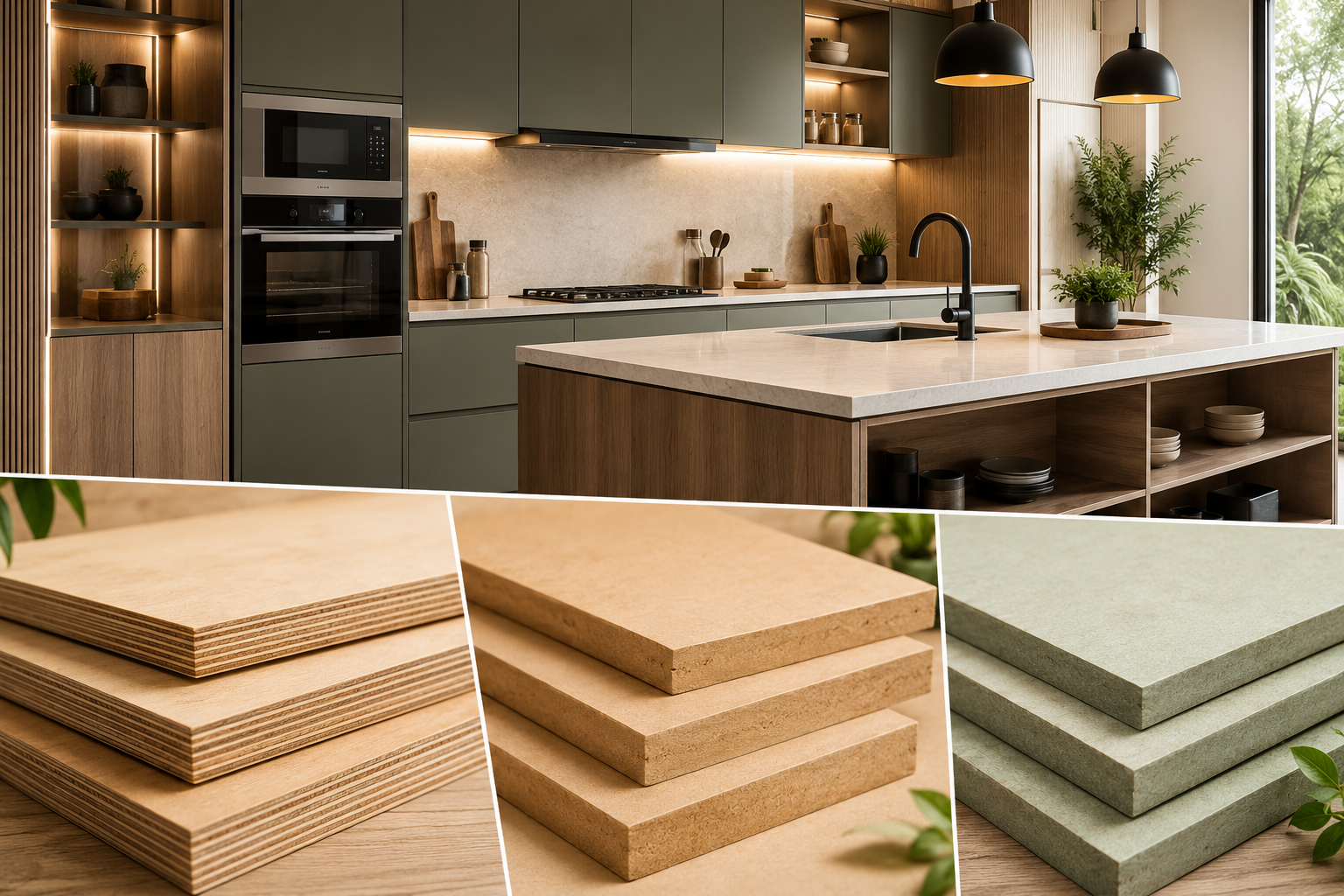
1. Plywood for Modular Kitchens
Plywood is one of the most widely preferred materials for modular kitchen cabinetry. It is manufactured by bonding multiple layers of wood veneer together, with the direction of the grain alternating between layers.
This construction gives plywood excellent structural strength and makes it suitable for areas that need to support heavier loads.
Advantages of Plywood
Excellent Strength and Durability
Plywood is strong enough to handle heavy utensils, cookware, kitchen appliances, and frequently used drawers.
Good Screw-Holding Capacity
Kitchen cabinets require hinges, drawer channels, handles, baskets, and other hardware. Quality plywood offers good screw-holding strength, making it suitable for cabinets that are opened and closed frequently.
Moisture-Resistant Grades Available
BWR (Boiling Water Resistant) and BWP (Boiling Waterproof) plywood are commonly considered for kitchen applications where better moisture resistance is required.
Suitable for Heavy-Duty Applications
Its structural strength makes plywood particularly useful for base cabinets, sink units, tall cabinets, pantry units, and heavy drawers.
Where Can Plywood Be Used?
Plywood is suitable for:
- Base cabinets
- Sink units
- Tall storage cabinets
- Pantry units
- Heavy-duty drawers
- Cabinets supporting heavy utensils
- Moisture-prone areas with the appropriate plywood grade
For homeowners who prioritize durability and structural strength, good-quality plywood is often an excellent choice.
2. MDF for Modular Kitchens
MDF stands for Medium-Density Fibreboard. It is an engineered wood product made by combining fine wood fibres with resin and compressing them into dense, uniform boards.
Unlike plywood, MDF does not contain visible layers or natural wood grain. Its smooth and consistent surface makes it particularly useful for decorative applications.
Advantages of MDF
Smooth Surface
MDF provides a very smooth surface, making it suitable for paint, laminates, veneers, and other decorative finishes.
Ideal for Decorative Designs
MDF can be routed and shaped easily, making it a popular option for decorative shutters and detailed cabinet designs.
Budget-Friendly
Standard MDF is generally more economical than premium plywood, making it useful for budget-conscious interior applications.
Uniform Appearance
Its consistent surface makes it possible to achieve clean and contemporary finishes.
Limitations of MDF
Standard MDF has limited resistance to prolonged water exposure. If water penetrates the board, it can swell and lose structural integrity.
It also generally offers lower screw-holding strength than good-quality plywood, making material selection particularly important for heavy-duty cabinets.
Where Can MDF Be Used?
MDF can be considered for:
- Decorative kitchen shutters
- Wall cabinets away from wet areas
- Routed shutters
- Painted cabinet fronts
- Decorative interior panels
- Budget-friendly kitchen designs
For areas around the sink or locations frequently exposed to moisture, other moisture-resistant materials may be preferable.
3. HDHMR for Modular Kitchens
HDHMR stands for High-Density High Moisture Resistance board. It is an engineered board designed to provide greater density and improved moisture resistance compared with conventional MDF.
HDHMR has become increasingly popular in modern interior applications because it combines a smooth finish with good density and moisture resistance.
Advantages of HDHMR
Better Moisture Resistance
HDHMR offers improved resistance to moisture compared with standard MDF, making it useful for kitchen environments.
High Density and Strength
Its dense construction provides better structural performance for a variety of cabinetry applications.
Smooth Surface
HDHMR provides a smooth surface that works well with laminates, paints, and contemporary finishes.
Suitable for CNC Designs
It can be routed and machined to create decorative patterns, making it suitable for customized kitchen shutters.
Versatile Applications
HDHMR can be used for kitchen cabinets, shutters, wardrobes, vanities, storage units, and other interior furniture.
Where Can HDHMR Be Used?
HDHMR can be considered for:
- Kitchen shutters
- Wall cabinets
- Selected base cabinets
- CNC-designed shutters
- Decorative panels
- Moisture-resistant interior applications
- Contemporary kitchen cabinetry
However, moisture-resistant does not mean completely waterproof. Proper edge sealing, installation, plumbing, and maintenance remain important.
Plywood vs MDF vs HDHMR: Quick Comparison
| Feature | Plywood | MDF | HDHMR |
| Strength | Excellent | Moderate | Good |
| Moisture Resistance | Good to Excellent* | Limited* | Good |
| Screw-Holding Capacity | Excellent | Moderate | Good |
| Smooth Finish | Good | Excellent | Excellent |
| Decorative Designs | Good | Excellent | Excellent |
| Heavy-Duty Applications | Excellent | Limited | Good |
| Budget | Higher | Economical | Moderate to Higher |
*Actual performance depends on the grade, manufacturer, finishing, installation, and exposure conditions.
Which Material Is Best for a Modular Kitchen?
There is no single material that is perfect for every component of a modular kitchen.
For example, quality plywood may be preferred for structural cabinets and heavy-duty applications, while MDF can be useful for decorative shutters where moisture exposure is limited. HDHMR can provide a balance between moisture resistance, density, and a smooth decorative finish.
Therefore, the best approach is to select materials according to the function and location of each cabinet.
Consider the following factors before making your decision:
- Kitchen size and layout
- Daily cooking requirements
- Exposure to moisture
- Cabinet load
- Storage requirements
- Hardware selection
- Desired finish
- Maintenance
- Budget
Professional planning can help combine different materials effectively to achieve durability without compromising aesthetics.
Other Important Elements of a Durable Modular Kitchen
Selecting the right board is only one part of creating a long-lasting kitchen.
Quality Hardware
Hinges, tandem drawers, drawer channels, lift-up mechanisms, handles, and storage accessories experience daily use. Choosing quality hardware can improve both convenience and cabinet longevity.
Proper Edge Sealing
The exposed edges of engineered boards require appropriate finishing and sealing. Proper edge treatment helps reduce moisture penetration and improves the overall finish.
Smart Storage
Pull-out baskets, bottle pull-outs, corner units, overhead cabinets, tall pantry units, and customized drawers can maximize available kitchen space.
Good Ventilation
A properly ventilated kitchen helps manage heat, smoke, steam, and moisture. Chimneys and exhaust systems can further improve the cooking environment.
Proper Plumbing
Water leakage can damage kitchen cabinetry over time. Plumbing around the sink and other wet areas should therefore be installed and maintained carefully.
Professional Installation
Even premium materials may not perform as expected if measurements, fittings, edge finishing, hardware installation, or alignment are poor. Professional execution is therefore just as important as material quality.
Common Mistakes to Avoid When Choosing Kitchen Materials
When selecting materials for your kitchen, avoid making decisions based only on price or appearance.
Some common mistakes include:
- Using standard MDF in areas frequently exposed to water
- Not checking the grade of plywood
- Assuming moisture-resistant boards are completely waterproof
- Selecting low-quality hinges and drawer channels
- Ignoring edge sealing
- Using the same material for every kitchen component without considering its purpose
- Ignoring cabinet load requirements
- Prioritizing appearance over structural durability
A well-designed modular kitchen should create the right balance between strength, functionality, aesthetics, storage, and budget.
Choose the Right Materials with Nest In Modulars
The right material can make a major difference in how your kitchen looks, functions, and performs over the years.
At Nest In Modulars, we focus on creating customized interiors that combine premium materials, modern technology, smart furniture, and thoughtful layouts. Our modular kitchen solutions are designed to maximize available space while delivering practical storage, elegant finishes, and comfortable everyday functionality.
Whether you prefer an L-shaped kitchen, U-shaped kitchen, parallel kitchen, straight kitchen, peninsula kitchen, or island kitchen, material selection should always complement the layout and intended usage.
Explore our Premium Modular Kitchens in Hyderabad to find customized kitchen designs, intelligent storage solutions, modern finishes, and functional layouts for your home.
Final Thoughts
Plywood, MDF, and HDHMR each offer different benefits for modular kitchens.
Plywood is an excellent choice when strength, durability, and screw-holding capacity are priorities. MDF works particularly well for smooth decorative finishes and budget-friendly applications where moisture exposure is limited. HDHMR provides a good combination of density, smooth finishing, and improved moisture resistance.
Instead of simply asking whether plywood, MDF, or HDHMR is best, consider which material is best for each component of your modular kitchen.
The right combination of materials, quality hardware, intelligent storage, suitable finishes, and professional installation can help create a modular kitchen that remains stylish, functional, and durable for years.